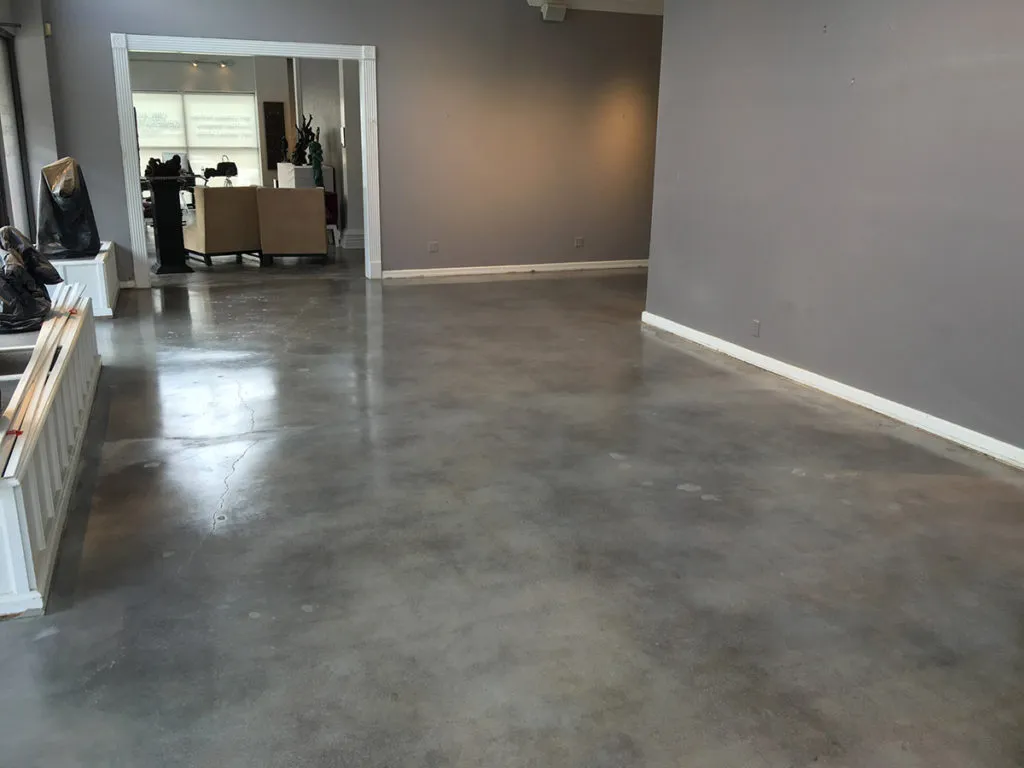
Some things that worry owners in the first weeks are normal, and some are faults the installer should put right. Heat is behind many of the real faults in this area, because concrete placed on a 110-degree afternoon behaves very differently from concrete placed at sunrise.
Why is my new concrete already cracking?
New concrete cracks because it shrinks as it loses water, and in the desert it loses water quickly. Fine cracks that appear in the first hours or days are plastic shrinkage cracks, caused by sun, wind and low humidity drying the top faster than the rest. Straight cracks along the joints are the joints doing their job. Random cracks across the middle of a panel point to joints that were too far apart, too shallow or cut too late.
Is the contractor responsible for a crack that shows up weeks later?
It depends on the crack and on your contract. No contractor can promise crack-free concrete, and a hairline crack is not normally treated as a defect. The contractor is responsible when the crack comes from the workmanship: a slab thinner than the contract says, missing joints, a base that was never compacted. Photograph the crack with a coin for scale, note the date and send it to the contractor in writing.
Why does my new concrete have dark and light patches?
Dark and light patches in the first month are mostly moisture leaving the slab unevenly. Shaded parts stay darker for longer. The colour usually evens out over a few weeks. Blotches that stay can come from two truckloads with slightly different mixes, from water sprinkled on during finishing, or from hard troweling in places. On coloured concrete these differences show more.
What happens if it rains on fresh concrete?
If it rains on fresh concrete before it has stiffened, the rain can wash cement off the top and leave a soft, dusty or pitted surface. A monsoon cell can form over the McDowells in half an hour, so summer pours are planned around the forecast and plastic sheeting is kept on site. Rain that falls once the surface has set does no harm. To check for damage, drag a screwdriver across the slab after a week. A surface that scratches into powder is weak.
There are footprints, rough spots and low spots, and the new pad is out of level. What can be done?
Footprints and rough patches are finishing faults and they do not go away. Small ones can be ground and sealed. Low spots that hold water, known as birdbaths, can be filled with a bonded topping, although the patch will show. A pad that is out of level is judged against what it is for: a patio should slope gently away from the house, so it is not meant to be dead level, while a shed or hot tub pad should be. Put a long level on it and write down the numbers before you call the installer.
Are control joints really necessary, and is a saw-cut a week later too late?
Yes, control joints are necessary. They are planned weak lines that make the slab crack straight and out of sight. A week later is far too late to saw-cut them. In Arizona heat the slab starts to shrink within hours, so joints are tooled while the concrete is soft or sawn the same day, often by the same evening. Cutting after cracks have formed only adds lines.
My slab was poured without rebar or mesh and I found out after. Is it ruined?
No. A patio or walk poured without rebar or mesh on a firm, compacted base can serve for decades. Steel does not stop cracks. It holds the two sides of a crack tight and level. Without it, a crack that forms is freer to open or step. If the contract listed reinforcement and none went in, you did not get what you paid for, and that is something to raise in writing.
My new stamped concrete is slippery. What can I do?
A slippery stamped surface is almost always the sealer, not the concrete. A glossy film sealer on a smooth pattern is slick when wet, which matters most around a pool. The fix is to recoat with a grit additive mixed into the sealer, or to strip the gloss and use a matte penetrating product. Ask for the non-slip additive before the first coat next time.
Why is my stamped concrete fading, cloudy or peeling?
A cloudy or white haze means moisture is trapped under the sealer, or the sealer went on too thick or over a damp slab. Peeling means it did not bond. Fading is the Arizona sun breaking down the sealer and, with some products, the colour. All three are sealer problems in most cases. The usual cure is to strip or re-dissolve the coating and apply a thin coat of a UV-stable sealer early in the morning when the slab is cool.
The surface is flaking within the first year. Is that normal?
No. Flaking in the first year points to a weak surface. Up north this shows after the first winter and is blamed on frost and deicer. Here the cause is nearly always the pour day: extra water at the truck, water flicked on while troweling, or a surface that dried out in hot wind before it could cure. Report it to the installer in writing while it is fresh.
It was poured in extreme heat and now it looks bad. Is that the weather or the contractor?
Both, but managing the weather is the contractor's job. Concrete poured in extreme heat sets fast, which leaves less time to finish and invites cracking, rough texture and colour differences. Crews here deal with that by starting at dawn, ordering a mix with a retarder or chilled water, dampening the base, and curing the slab as soon as it is finished. If the pour started at midday in July with none of that, the heat is not much of an excuse.
The stamped pattern is crooked and I have not paid the final balance. What now?
Raise it in writing before you pay the final balance. Describe the problem, attach photos and ask for a proposed fix by a set date. Holding back an amount that fairly matches the defect is common while you agree a remedy. Holding back everything for a small flaw can put you in breach of the contract. A crooked pattern cannot be re-stamped, so the realistic outcomes are a price reduction, a colour or overlay correction, or replacing the panel.
The crew left ruts in the yard, washout, splatter and the forms still on. Who fixes that?
The contractor does. Tire ruts, concrete washout dumped in a planter or on the desert floor, and splatter on stucco or a garage door are damage, and cleanup is part of any reasonable contract. Forms normally come off within a day or two. Forms left on for weeks swell and bind, and pulling them can chip the slab edge, so ask for them to be removed promptly. Take photos and send one written list.
What can I do if the contractor will not come back to fix it?
Start with a dated written request that lists the defects and gives a deadline. If the contractor will not come back, and is licensed, you can file a complaint with the Arizona Registrar of Contractors. The Registrar says a complaint must be filed within two years of the date the work was last performed. Customers of licensed residential contractors may also be able to claim from the Residential Contractors' Recovery Fund, up to $30,000. An unlicensed contractor leaves you with small claims court or an attorney.
Your own price comes from a free visit, a tape measure and a written quote. Call (480) 771-7722 or text a photo of the area.